
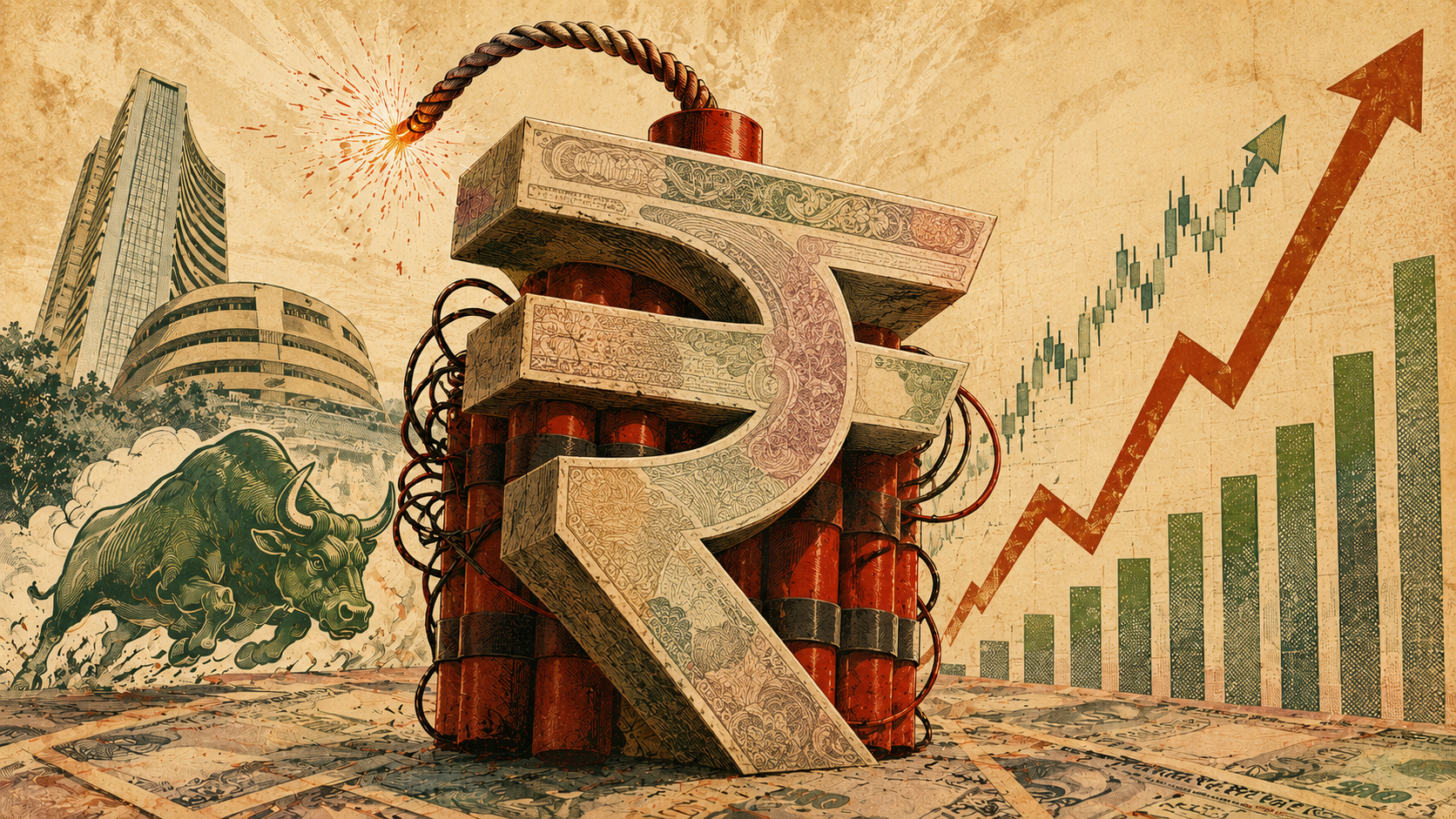
On paper, India looks like the undisputed star of the global economy. A contained current account deficit, political stability that would make most democracies envious, and a GDP trajectory that has Western institutions tripping over themselves to revise their forecasts upward. Prime ministers pose with semiconductor executives. Foreign ministers broker landmark trade corridors. The world is told, repeatedly, that this is India's century.
But a growing number of economists and policy analysts are sounding a quieter, more uncomfortable alarm. The very policies generating today's headline numbers are systematically dismantling tomorrow's growth engine. And the window to course-correct, they warn, is narrowing fast.
The Fortress Economy Trap
At the core of India's current economic strategy is the Atmanirbhar Bharat philosophy — self-reliance, domestic manufacturing, reduced dependence on foreign supply chains. The intent is broadly defensible. The execution, however, has quietly become a crisis.
Between 2017 and 2024, the number of Quality Control Orders (QCOs) — regulatory mandates that effectively restrict imports by setting standards few foreign suppliers bother to meet — exploded from 14 to over 765. That is not a policy adjustment. That is a wall being built, brick by quiet bureaucratic brick.
The original promise of QCOs was legitimate: protect Indian consumers from substandard goods, encourage local production of quality alternatives. In practice, economists argue, domestic industrialists weaponized the mechanism. Rather than investing in genuine innovation to compete, India's legacy monopolies in steel, cement, and traditional manufacturing used QCOs as a moat — keeping out better, cheaper intermediate goods that their own supply chains desperately needed.
The result is a cruel paradox: the very small and medium enterprises that India needs to upgrade are being starved of the world-class inputs required to do so. Denied access to affordable, high-precision components, our MSMEs produce finished goods that simply cannot compete internationally.
A fortress economy, analysts conclude, ensures short-term survival but guarantees long-term stagnation within the middle-income trap. You cannot tax and protect your way into becoming a superpower.
The Investment Treaty Disaster Nobody Is Talking About
If the QCO surge is a slow bleed, India's Bilateral Investment Treaty (BIT) architecture is the tourniquet someone forgot to loosen.
In 2015, following a string of bruising defeats in international arbitration — most famously against Vodafone and Cairn Energy — India revised its BIT framework and imposed a mandatory five-year local court exhaustion rule. Before any foreign investor could access international arbitration, they had to first exhaust remedies in Indian courts, a process notorious for backlogs that stretch across decades.
The intention was to protect sovereignty. The outcome, economists argue, was to scare away capital.
Foreign direct investment is, above all else, risk-averse. A global semiconductor manufacturer weighing a billion-dollar factory in India against Vietnam, Mexico, or Malaysia is not making a patriotic choice. They are running a spreadsheet. And on that spreadsheet, "wait five years before you can access neutral arbitration on a contract dispute" is a line item that kills deals before they start.
Analysts model this relationship starkly: FDI inflows move in inverse proportion to mandated litigation time and perceived risk of retrospective taxation. Set the litigation clock to five years, and you drive away precisely the high-stakes frontier investment — advanced manufacturing, AI infrastructure, aerospace — that India most urgently needs.
The irony is exquisite. India revised its BIT framework to stop losing arbitration cases. Instead, it stopped attracting the investments that would have generated those cases in the first place.
The Complacency Dividend
What makes this genuinely dangerous is not that the problems are invisible. It is that things look good enough that fixing them feels optional.
Political dominance at the Centre provides the mandate necessary for difficult structural reforms. It also, analysts note, breeds the belief that current policy is sufficient. Why absorb the short-term political cost of dismantling legacy monopolies — whose owners are significant donors and power brokers — when the quarterly numbers still look respectable?
But the early tremors are already visible. India ranks 16th globally in per capita GDP growth, a ranking that flatters no one's civilizational ambitions. The Rupee's persistent depreciation is not a random market event — it is a signal that the productive capacity of the underlying economy is not keeping pace with its nominal growth. Total Factor Productivity, the measure of how efficiently an economy converts inputs into outputs, is quietly degrading.
These are not catastrophic numbers. They are the numbers of an economy that is slowly, politely, falling behind.
What a Real Fix Would Look Like
Economists broadly agree the prescription needs to be as aggressive as the diagnosis. The broad strokes of what serious reform would require look roughly like this:
Open the economy asymmetrically. Rather than a politically suicidal across-the-board tariff reduction, establish zero-tariff corridors specifically for frontier-technology components — advanced GPUs, aerospace materials, edge-computing chips, AI infrastructure hardware. Legacy monopolies have no footprint in these sectors, so there is no domestic lobby powerful enough to kill the move. Foreign capital flows in, building next-generation industries before the old guard knows what happened.
Resolve the BIT crisis surgically. Build hyper-modern Special Economic Zones with a legally distinct arbitration framework inside their borders. Within those zones, foreign companies get access to international arbitration in Geneva, Singapore, or London. Outside the zones, Indian judicial sovereignty remains intact and untouched. The concession is geographically ring-fenced. The capital is not.
Upgrade MSMEs through algorithmic credit, not subsidies. Deploy AI-driven credit systems to fund small manufacturer upgrades — but with a strict condition: the money can only be spent on world-class precision machinery. Then legally mandate that foreign mega-factories must integrate qualifying domestic suppliers into their supply chains. Force the technology transfer, rather than hoping it happens organically.
Protect workers, not monopolists. Before any tariff is cut on legacy sectors, announce a substantial national reskilling and transition fund. Any worker displaced by the bankruptcy of an inefficient domestic firm receives guaranteed income support, paired with mandatory upskilling for the precision manufacturing jobs being created in new industrial zones. This deliberately severs the political alliance between blue-collar workers and the billionaire owners of inefficient industries — the most powerful domestic resistance to reform.
The Deeper Game
What is most striking about how serious economists frame this challenge is the ultimate ambition involved, extending well beyond GDP targets and export rankings.
The argument goes like this: if India successfully pivots from import substitution to becoming a central node in global value chains — if Apple, Lockheed Martin, TSMC, and major AI laboratories have hundreds of billions of dollars in physical assets permanently anchored on Indian soil — then India's economic stability becomes an existential requirement for the Western world. Not a preference. A requirement.
In that scenario, economic openness becomes the most powerful instrument of national security India has ever possessed. A country deeply embedded in global supply chains does not need to beg for international support when threatened. The world's financial markets demand it automatically.
The Clock Is Running
None of this is guaranteed to happen. The legacy industrialists being asked to accept competition are not powerless. Judicial challenges to any new arbitration framework will be real. The short-term political costs of reform are always more visible than the long-term costs of inaction.
And that, ultimately, is the time bomb economists are pointing at — not a crash, not a crisis, not a dramatic collapse. Something quieter and harder to televise: the steady, compound loss of decades that cannot be recovered, because the window for structural reform was left open too long and then quietly shut.
The economy looks strong. That is precisely when surgery is possible. It is also precisely when no one feels the urgency to pick up the scalpel.

